
Operation Noble Eagle - October 13th VFW/American Legion Del City
Watch Live HERE or Watch Recording
The link above will go “live” the day of the event.
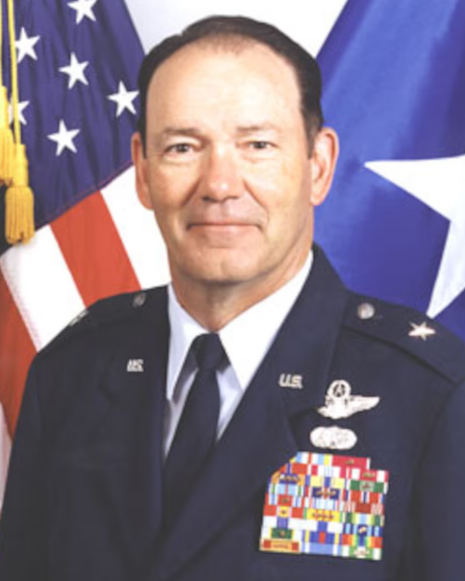
USAF Retired Brig Gen Ben T. Robinson
Ben Robinson was born into an Air Force family in San Antonio, TX. His father was stationed at Randolph Field at the time. He grew up in Clovis, New Mexico and considers Clovis his hometown.
Ben joined the US Army in December 1968. After a delayed enlistment, he came on active duty in February 1969. He was selected for Warrant Officer Helicopter Pilot Training during basic training. He graduated from Army pilot training in January 1970. He served as a Chinook pilot in Viet Nam in 1970-1971.
Ben left the Army in 1972 to return to college. After graduating from college in 1973, he enlisted in the Air Force, attended Officer Training School and Undergraduate Pilot Training. After receiving his wings, he flew the B-52, CH-3, E-3, E-6, E-8, and TC-18. He has almost 5000 hours from both services.
He was assigned to US European and US Space Command as joint assignments. He commanded the USSPACECOM Space Defense Operations Center, the 552nd Operations Group, the 93rd Air Control Wing (Joint Stars) and the 552nd Air Control Wing (AWACS). He was a Director on the Air Staff and Vice
Commander of 8th Air Force. Ben was the AWACS commander on the morning of 9/11. Ben retired from almost 34 years of service on 31 October 2002.
After his retirement, Ben was a Boeing executive, the president of an aerospace consulting company and the Secretary of Military and Veterans Affairs for Oklahoma. Ben is an inductee to the Oklahoma Military Hall of Fame.
Ben attended Eastern New Mexico University, Central Michigan University, and the Massachusetts Institute of Technology.
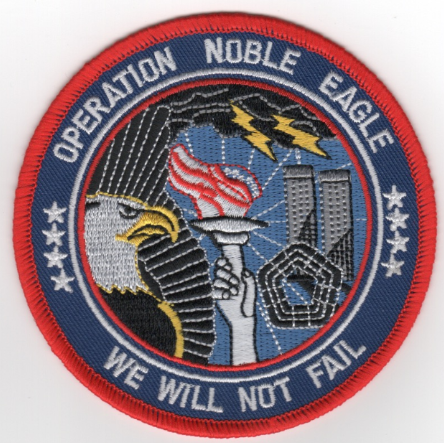
Operation NOBLE EAGLE (ONE)
Operation NOBLE EAGLE is the name given to all North American Aerospace Defense Command (NORAD) aerospace warning, control, and defense missions in North America. Through Operation NOBLE EAGLE, NORAD deters, detects, and defeats potential threats to U.S. and Canadian airspace 24/7/365.
History
The Chairman of the Joint Chiefs of Staff designated military operations supporting homeland security as Operation NOBLE EAGLE, following the terrorist attacks of September 11, 2001. While NORAD's mission has always been to defend the airspace of the U.S. and Canada, prior to 9/11 NORAD was primarily postured to look outward.
Over the last two decades, NORAD's mission has changed to include a focus on threats that may originate within the U.S. and Canada, and the addition of a maritime warning mission.
NORAD Regions
NORAD has three subordinate regions: the Alaskan NORAD Region (ANR), the Canadian NORAD Region (CANR), and the Continental U.S. NORAD Region (CONR). Together, the three NORAD regions provide airspace surveillance and control, and directs air sovereignty activities for their respective airspace.
Aerospace Control
NORAD ensures U.S. and Canadian aerospace control, to include air defense operations, through a network of alert fighters, tankers, airborne early warning aircraft, rotary wing air interceptors, and ground-based air defense assets cued by interagency and defense radars.
By using this network of sensors, NORAD detects airborne objects approaching North America and conducts its air defense mission by tracking, identifying, and taking appropriate actions. Appropriate actions may include, but are not limited to, monitoring a track, scrambling fighters to intercept and identify an approaching aircraft, and/or escorting an aircraft through an Air Defense Identification Zone (ADIZ) or a Temporary Flight Restriction Area.
An ADIZ begins where sovereign airspace ends and is a defined stretch of international airspace that requires the ready identification of all aircraft in the interest of national security. There are three ADIZ identified for North America: Alaska ADIZ, Canada ADIZ, and Contiguous U.S. ADIZ (Continental U.S.).
Air Defense Operations
Temporary Flight Restriction Areas (TFRs)
NORAD closely coordinates air defense activities with the Federal Aviation Administration (FAA) and NAV Canada, monitors those operations and responds to requests for assistance and emergency situations.
NORAD works with the FAA and NAV Canada to enforce temporary flight restriction areas, often referred to as TFRs.
Aircraft with an approved flight plan that takes them through a TFR are authorized to fly in a TFR. Pilots must also be in communications with ATC, have their transponder on and squawking throughout their transit into the TFR. If a pilot unknowingly or intentionally enters a TFR in violation of FAA or NAV Canada requirements, NORAD responds.
NORAD interceptors will safely and professionally attempt to gain compliance of a violating pilot and communicate a desired course of action.
NORAD fighters or helicopters are typically used as a last resort and are often used because other attempts at communication have failed. NORAD efforts could include guiding the pilot out of the TFR or instructing them to land at the nearest suitable airfield.
Through the execution of Operation NOBLE EAGLE, NORAD deters, detects and denies, potential threats to Canadian and U.S. airspace around the clock, with a 360-degree defense of North America.
Current a/o Sept. 7, 2023